About Tonto's Expanding Head Band
**Tonto's Expanding Head Band** was a British-American electronic music duo established in the early 1970s by [[artist:Malcolm Cecil]] and [Bob Margouleff](https://discogs.com/artist/57946). The project evolved around the custom-built multitimbral polyphonic analog synthesizer, **T.O.N.T.O.** (The Original New Timbral Orchestra) — featured on the band's two albums and several records by **[[artist:Stevie Wonder]]**, their most notable collaborator, [[artist:The Isley Brothers]], and other prolific artists. Since 2013, the TONTO synth has been in the collection at the [[label:National Music Centre]] in Calgary, Alberta, Canada.
T.O.N.T.O.'s development began with two [Moog](https://discogs.com/label/221419) *Series III* modular synths (one of which belonged to Margouleff), merged and housed in curved wooden 20×6 ft cabinets. Cecil had several technicians and engineers who helped maintain T.O.N.T.O., which had dozens of sensitive oscillators that required constant recalibration. His partners included [[artist:Rex Probe]], whom he met in early 1971 during a session at [[label:Electric Lady Studios]] in New York, and [[artist:Kevin Braheny]]. Circa 1973–74, when T.O.N.T.O. was at the [Record Plant Studio](https://discogs.com/label/304319) in LA, Probe introduced Cecil and Braheny to a new **Serge Modular** system recently launched by [CalArts](https://discogs.com/label/156314) professor, composer, and inventor [[artist:Serge Tcherepnin]]. Soon after, Serge and Rex designed a "*New Timbral Oscillator*" (NTO) module; to preserve T.O.N.T.O.'s visual consistency, NTOs had Serge Modular's iconic white panels with bright-colored connectors replaced with "faux" Moog-styled black decals. Collaboration with Serge inspired Malcolm Cecil to expand T.O.N.T.O. with modules from other manufacturers, all hidden under unified black panels: four [Oberheim](https://discogs.com/label/369848) *SEM* units, two [ARP](https://discogs.com/label/183466) *2600*, and other components by [EMS](https://discogs.com/label/131469), [Roland](https://discogs.com/label/459964), [Yamaha](https://discogs.com/label/77770), and Blacet Research. In later years, some digital synthesizers and an array of MIDI-controlled sequencers enhanced TONTO's purely analog circuitry.
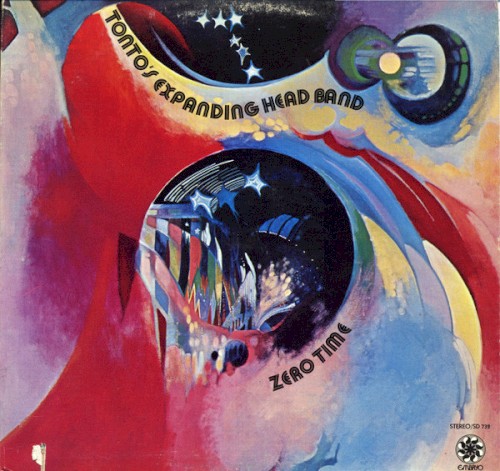
In June 1971, Cecil and Margouleff presented their debut album as "Tonto's Expanding Head Band," *[m=45040]*, which came out on [[label:Embryo Records]] in the US and [[label:Atlantic]]/[[label:Polydor]] in the UK. Despite lack of commercial success, most critics praised *Zero Time*, with glowing reviews in [[label:Rolling Stone]], [Billboard](https://discogs.com/label/1312199), and [Sounds](https://discogs.com/artist/2975525) magazines; the album gained cult status among audiophiles, industry professionals, and experimental electronica fans. [[artist:Stevie Wonder]], in particular, was so impressed upon hearing the *[m=45040]* LP that he immediately invited Malcolm and Bob to collaborate. T.O.N.T.O. appeared on four of Stevie Wonder's studio albums, all crediting Margouleff and Cecil as associate producers, engineers, and programmers: *[m=87436]* and *[m=87446]* in 1972, *[m=86466]* (which earned Malcolm and Robert the "Best Engineered Non-Classical Recording" Grammy award), and *[m=87463]* (74). The duo worked with other high-caliber artists and bands across genres, including three albums by **[[artist:The Isley Brothers]]** that featured T.O.N.T.O. — *[m=82584]* (1973), *[m=82650]* (74), and *[m=82652]* (75) — and records by [[artist:Gene Parsons]], [[artist:Steve Hillage]], [[artist:Billy Preston]], and [[artist:Weather Report]]. Besides T.O.N.T.O. studio sessions, Cecil and Margouleff also programmed Moog and ARP synths for various musicians and producers, such as [[artist:Quincy Jones]], [[artist:Bobby Womack]], [[artist:Ravi Shankar]], [[artist:Stephen Stills]], [[artist:Dave Mason]], [[artist:The Doobie Brothers]], and [[artist:Little Feat]].
In December 1974, **TONTO**'s sophomore album, *[m=436477]*, came out on [[label:Polydor]] in Europe and the UK. Even though it wasn't distributed in the United States, T.O.N.T.O. synthesizer made a Hollywood cameo, appearing in [[artist:Brian De Palma]]'s comedy/horror *[Phantom of the Paradise](https://discogs.com/master/198060)* in October 1974. The following year, [[label:Atlantic]] re-released the band's debut album with [an alternative artwork](https://discogs.com/release/212965) in the USA/Canada. [[artist:57947]] used the T.O.N.T.O. synth on their *[m=7874]* album on [[label:Arista]], pictured with the instrument on the front and back covers. In 1975, Malcolm Cecil bought out Bob Margouleff's share and became the sole owner of T.O.N.T.O. synthesizer. In the mid-1990s, the system resided at [[label:Mutato Muzika]] studios in West Hollywood, a home base of [[artist:Devo]]'s co-founder [[artist:Mark Mothersbaugh]], before returning to Cecil's home in Saugerties, New York. In 1996, the *[m=379587]* CD compilation came out on [Viceroy](https://discogs.com/label/511442), featuring tracks from *Zero Time* and *It's About Time* albums. (Ten years later, Malcolm Cecil privately reprinted it as a [limited edition CD](https://discogs.com/release/797328) with a bonus track).
In late 2013, the Canadian [[label:807867]] in Calgary, Alberta, purchased T.O.N.T.O. from Cecil, placing it on the public exhibit. [[artist:John Leimseider]] at NMC completed a multi-year restoration in 2017, repairing all broken components and worn-out jacks so the instrument is fully playable.