About Psygone
Overview
Psygone is a pioneering Danish psychedelic trance project led by Michael Kjeldgaard. Known for a signature "vibrating" sound that bridges the gap between melodic Goa trance and the driving energy of German acid trance, Psygone became a staple of the 1990s electronic scene. The project’s sound was heavily shaped by influences such as Astral Projection, X-Dream, Miranda, and Man With No Name.
History
Formation (1994): The project was founded as a duo consisting of Michael Kjeldgaard and Robert Christensen. Their early objective was to fuse the melodic sensibilities of the emerging Goa scene with the harder, acid-driven sounds of the German trance movement.
Transition (1995): Despite performing across various venues in Denmark, the duo initially struggled to secure a record deal. In 1995, Robert Christensen departed the project. Kjeldgaard continued as a solo artist, refining the production quality and sonic direction of Psygone. This evolution led to his first major signing with Hypnotic Records.
Expansion (1996): Jan Bachmann joined the project, contributing what the duo described as "Positive Energy and Good Karma" to the production process.
The Golden Era (1997–1999): The project gained international recognition within the trance community during the late 90s, characterized by high-profile performances and the release of their defining studio work.
Discography
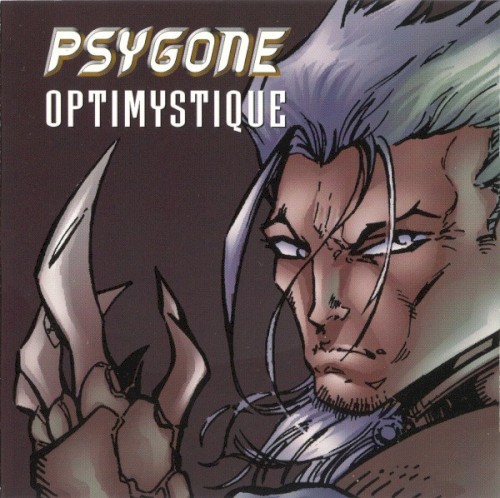
Optimystique (1997): The debut full-length album, released to critical acclaim within the Goa trance scene.
Organique (1998): Originally intended as the follow-up album, Organique was never officially released as a standalone LP. However, its tracks were widely distributed across various electronic music compilations, becoming sought-after pieces for collectors.
Live Performances
Psygone has been a prominent fixture at Danish festivals and Goa events. They have shared the stage with legendary electronic acts and DJs, including:
Pascal F.E.O.S.
Der Dritte Raum
Armitage Shanks
Tom Wax
The Psygone Studio (Hardware & Instrumentation)
The Psygone sound is defined by a curated collection of classic hardware synthesizers, samplers, and modules. Below is the chronological timeline of the instruments used in their productions, spanning from early analog classics to the digital powerhouses of the late 90s:
1983: Roland JX-3P (Polyphonic Analog Synthesizer)
1984: Roland Juno-106 (Programmable Analog Polyphonic Synthesizer)
1987: Yamaha TX81Z (FM Tone Generator)
1988: Roland D110 (Multi-timbral Linear Sound Module)
1989: Roland W30 (Music Workstation/Sampler)
1991: Roland JD800 (Programmable Digital Synthesizer)
1993: Novation Bass Station Mk1 (Analog Mono-Synth)
1993: Quasimidi Quasar (Multi-timbral Rack Module)
1994: Braintec Transistor Bass / Transistorbass 3 (TB-303 Clone)
1994: Roland JV-1080 (64-Voice Synthesizer Module)
1995: Waldorf Pulse (Monophonic Analog Rack Synth)
1996: Novation Drumstation (Analog Modeling Drum Module)
1996: Roland JP8000 (Analog Modeling Synthesizer)
1997: Access Virus A (Virtual Analog Synthesizer)
1999: Akai MPC 2000XL (MIDI Production Center/Sampler)